Bloomberg for B2B Go-To-Market
The investment thesis argued through one analogy. Every layer Bloomberg owns in financial markets, Omnitech is building in revenue markets. Designed for a single read.
Read the PDFFive coordinated businesses, built around the orchestration layer of the modern revenue stack. Built for the decade that replaces the 2022 GTM playbook — assembled in months, not years. Decision-maker access, on the buyer’s invitation.
Earned through editorial intelligence senior buyers actually read, community senior buyers actually join, and a data contract that protects what they say in the room. Each surface compounds the invitation. The invitation is the moat.
The landing page is the living version. The two documents below are curated artifacts for deeper reading, sharing with colleagues, or diligence.
The investment thesis argued through one analogy. Every layer Bloomberg owns in financial markets, Omnitech is building in revenue markets. Designed for a single read.
Read the PDFThe operational argument. Market shift, $235B+ opportunity, the five-unit operating group, the closed-loop moat, competitive defensibility, and a roadmap of key milestones. Built in months, not years — the speed AI plus senior operators unlocks.
Read the PDFFor twenty years, Go-To-Market was a department. A team that ran marketing, sales, and revenue operations — downstream of product, downstream of engineering, downstream of finance. Something a company had, not something a company was built around.
In an AI-native stack, that has changed structurally. The modern B2B revenue architecture has five layers. Four of them are commoditising. The fifth is where the next decade of category value accrues.
Every decade, across industries, a new infrastructure layer emerges — and the companies that define that layer capture most of the category value it creates. This is not a pattern in technology. It is the pattern in how categories are built.
Every decade, a new infrastructure layer emerges — and the companies that define that layer capture most of the category value it creates. Bloomberg for capital markets. Gartner for enterprise IT. Salesforce for cloud CRM. HubSpot for inbound marketing. Palantir for decision infrastructure. Stripe for payments. Snowflake for the modern data layer. Two operators — Foundry and Informa TechTarget — have publicly named the next $20B opportunity at the GTM layer, four years apart.
Full pattern, mapped across nine firms and four category-creation movesIn each case, the pattern repeats: a layer that didn't exist as a category five years earlier becomes one of the most valuable layers in the stack. The companies that define those layers don't compete in a crowded category — they create the category other companies compete inside.
Go-To-Market infrastructure is the next. Omnitech Capital is building the operating group to define it.
The historical precedents above prove the pattern across decades. The same pattern is also playing out right now at the layer beneath GTM — the AI infrastructure layer — and the smartest infrastructure capital in the world is funding it.
On April 22, 2026, VAST Data closed a $1B Series F at a $30B valuation — backed by Nvidia, Drive Capital, Access Industries, Fidelity, and NEA, with $4B+ in cumulative bookings and $500M+ committed ARR. Customers include CoreWeave, xAI, JPMorgan Chase, Mistral, the U.S. Air Force, and Cursor. Founded in 2016, VAST set out to do something specific: collapse the fragmented AI infrastructure stack — storage, database, compute, agents — into a single integrated system. One platform, one data layer, one runtime. They call it the AI Operating System.
What VAST is building at the AI infrastructure layer is structurally identical to what Omnitech is building at the GTM layer. Same diagnosis — fragmentation. Same prescription — collapse the stack into an integrated system. Different domain.
The lower four layers are what most companies think of when they think “AI stack.” Data (ERP). Customer intelligence (CRM). Agentic AI. Foundation models. Each layer is getting more powerful every quarter. Each is also getting more commoditised every quarter — every vendor has access to the same CRM data, the same Claude API, the same agentic frameworks.
The differentiation is no longer who has the best model. The differentiation is who knows what to point the model at.

That question — what to point the model at — cannot be answered by any of the lower four layers. An LLM doesn’t know which market you should enter. An agentic AI doesn’t know which buyer segment is underserved this quarter. A CRM doesn’t know why its pipeline is decaying. Those answers live one layer above.
Without the GTM orchestration layer, the AI stack is a very fast engine with no destination.
An agentic layer without GTM context will generate outbound at scale — to the wrong accounts. A foundation model without GTM context will write perfect emails — with the wrong message. A CRM without GTM context will capture data — about buyers who were never going to convert.
The stack gets smarter every quarter. The results get worse every quarter. Because the layer that gives the stack direction is the layer most companies don’t have.
The integrated Go-To-Market stack Omnitech is building addresses a layered market spanning sales technology, revenue operations, demand generation, B2B marketing, GTM talent, media and community, and enablement training. Each segment is large on its own. None is currently owned by a vertically integrated operating group.
| Segment · Operating unit | Today | Projection |
|---|---|---|
| Sales Acceleration TechnologyENAI | $124.4B | $409.4B by 2033IMARC Group |
| CRM & Revenue OperationsENAI | $25.7B | $75.4B by 2029Gartner / Technavio |
| B2B Demand Generation ServicesIndustryGeniuses | $8.0B | $15.0B by 2033Strategic Revenue Insights |
| B2B Marketing SpendIndustryGeniuses + GTMplus | $18.9B | $30.8B by 2030Research and Markets |
| GTM Talent & Fractional ServicesGTM Bench | $14.2B | $25.9B by 2030Research and Markets |
| B2B Media, Events & CommunityGTMplus | $40.0B | $60.0B+ by 2030AMR / IAB / Statista |
| B2B Sales Enablement & TrainingGTM Institute | $5.7B | $11.8B by 2030Grand View Research |
The segments are separately large. The structural winners will be the groups that serve them as one.
The table is not a collection of adjacent markets — it is the architecture of the group. ENAI anchors Sales Acceleration and RevOps. IndustryGeniuses captures B2B Demand Generation and a share of B2B Marketing Spend. GTM Bench owns the GTM Talent and fractional operator segment. GTMplus sits across B2B Media, Events, and Community. GTM Institute addresses the Sales Enablement and Training layer focusing on new AI roles such as GTM Operator, AI Prompt Engineer, AI-enabled AE, AI Content Orchestrator, and AI RevOps Specialist etc. The investment thesis is that the next decade rewards the operating groups that integrate across them. Omnitech is building for that integration.
The current Go-To-Market category — the $235B+ that consolidates across the seven segments above — is itself in the process of expanding. AI applied to industry workflows is collapsing categories that ran in parallel for forty years. Advisory work, software implementation services, departmental operating budgets, and the GTM stack itself are converging into a single operating layer.
What was once sold as strategy decks and software implementation is being replaced by vertically focused AI agents that do the tasks. What used to be measured as Finance, Customer Service, HR, Operations, Logistics, or Legal output is increasingly measured against revenue contribution — because once routine work is performed by agents, the remaining human work re-anchors upstream to a single question: how does this create commercial growth?
Go-To-Market stops being a department. It becomes the operating system the entire enterprise runs on.
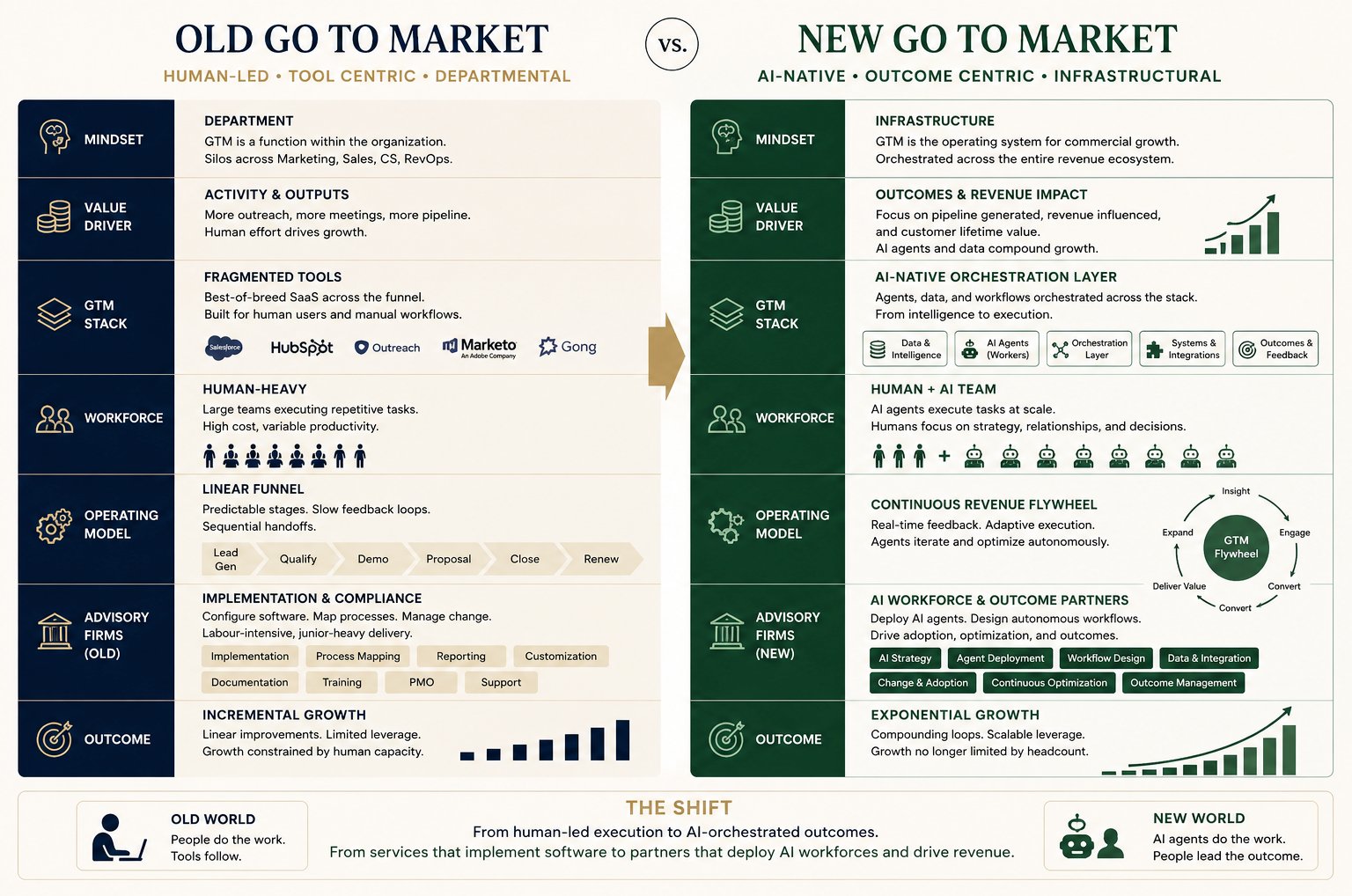
Omnitech is positioned for both the category as it stands today — the $235B+ that consolidates across the seven segments — and the operating system it is becoming.
The integration thesis is larger than the GTM category alone. Step back from the GTM stack and look at where commercial growth sits in the AI economy. The full chain runs from compute to GDP — and tokens, the unit of inference performed by digital workers, are the new economic primitive flowing through every link.
Jensen Huang's chain — compute → tokens → intelligence → digital workers → revenue → GDP — compresses two distinct stages into a single “Revenue” link. Unpack it, and the operating layer becomes visible: Industry GTM is where revenue is actually captured — the catalyst. Industry Transformation is where that revenue aggregates into sector-level change — the structural outcome.
What does this mean for the advisory layer specifically? The shift that reshapes software-implementation firms is the same shift that produces a new layer of AI-native industries — hospitals, retailers, manufacturers, financial services, logistics — all built around AI workforces orchestrated by partners, not implemented by consultants.
As the operating system for commercial growth absorbs the function-level work of every vertical, IndustryGeniuses is broadening from B2B demand generation execution into AI agents and digital labor deployed across industry verticals. The unit's mandate now matches the structural opportunity: every vertical needs the AI workforce, and every vertical's workflows ultimately route back to revenue.
The token economy creates value at two layers — Industry GTM and Industry Transformation. The advisory firms of the previous era become the AI-workforce orchestrators of the next. Omnitech operates at both layers — the GTM operating system and the AI-native industry layer. The convergence is now visible.
Omnitech Capital operates five coordinated businesses across the full Go-To-Market orchestration layer. Each is a standalone brand with its own customers, product, and economics. Together, they form the integrated operating group the category is moving toward.
The five operating units, their commercial models, and how each amplifies the others — in a single live view. Click any unit for its revenue streams, pricing structure, and ecosystem effects.
AI-native sales intelligence and engagement software. Built AI-first from the ground up — not AI bolted onto a legacy sales engagement tool. Signals, workflows, and automation across outbound, pipeline, and RevOps, built for how revenue teams actually work in the age of AI.
Senior fractional Go-To-Market operators — Director to CxO — deployed into B2B companies at the growth inflection. All four GTM disciplines: RevOps, Demand Generation, Marketing, Sales. Plus Industry Advisors with deep sector expertise. Operators who’ve led GTM at Salesforce, Google, AWS, McKinsey, Deloitte, PepsiCo, and Nestlé.
The execution agency for B2B companies that need real pipeline, not creative awards. Demand generation, ABM, content, and campaign execution — run by practitioners, measured against revenue outcomes, not vanity metrics.
Three editorial properties covering different tiers of the revenue decision chain. GTM Bench Review (live, weekly) for GTM practitioners. BoardroomAI (in build) for board directors and C-suite. VerticalAI (in build) for industry leaders. One editorial operation. Three audiences. A proprietary buyer-signal network covering verticals and decision-makers.
The customer-facing platform that unifies the portfolio. GTMplus directly operates the community and training layer — an open practitioner community, the VP+ Inner Circle with preferential commercial economics across the platform, GTMInstitute training, and GTM Summit London. Publications, software, operators, and agency all integrate through GTMplus.
Most Go-To-Market platforms are tool stacks bolted together through acquisition. Most Go-To-Market agencies don’t own proprietary media. Most Go-To-Market publications don’t have operator practices underneath them.
Omnitech Capital owns all three layers, built from the same thesis, under one coordinated group.
Our editorial properties cover industry verticals and C-suite decision-makers directly. The intent signals flowing through our network inform what we publish — and what our operators deploy into client engagements — before the market catches up.
The same senior GTM operators on our Bench contribute to our publications. Which means when a fractional CRO deploys into a client, they arrive with the context our editorial team has already compiled. The strategic onramp collapses from months to days.
ENAI is the AI-native execution layer. IndustryGeniuses is the agency delivery arm. Both ship the campaigns, workflows, and signals our operators and publications identified upstream. No handoff friction because there is no handoff.
GTMplus members receive preferential economics across the platform — turning single-product buyers into multi-product accounts, and turning customers into peer evangelists. Account LTV grows with every additional unit touched.
And tenure compounds the switching cost. Configured workflows, peer relationships, published contributions, tenure-weighted standing inside the VP+ Inner Circle — none of it travels. Cancelling the subscription is easy. Replacing what was built inside it is not.
This is not a flywheel diagram. It is the orchestration layer for modern revenue infrastructure.
SpaceX builds the rocket, the engines, the avionics, and operates the launches. Starlink — the global communications layer the rest of the ecosystem runs on — sits on top. Tesla, Optimus, xAI, X Corp, Neuralink, and The Boring Co. all run on the same vertically integrated infrastructure and engineering culture. The integration is not a side effect of common ownership — it is the design. Cost-per-kilogram collapsed 25x. The platform is structurally uncompetable.
Most companies in B2B Go-To-Market are a stack of vendors — a CRM, plus an intent-data provider, plus a martech agency, plus a community platform, plus a training company. Omnitech operates the integrated stack as one group — and owns the decision-maker layer (BoardroomAI, VerticalAI, GTM Bench Review, VP+ Inner Circle) that the rest of the stack runs on. Same architectural pattern, applied to a different category. The integration is the moat.
Read the SpaceX precedent →The case above, argued in full. What ZoomInfo and SciLeads teach us about defending B2B intelligence businesses in the age of agentic AI — and why, in 2026, anything that looks like a database loses and anything that looks like a network, a point of view, or earned judgment wins. Three-stage pattern, six-row moat taxonomy, portfolio flywheel analysis, and ninety-day priorities.
Read the memoPublications and the GTMplus community capture buyer signal at the source. GTM Bench operators translate it into strategy. ENAI and IndustryGeniuses execute into pipeline. Execution generates new proprietary data. Editorial and GTM Institute training close the loop — compounding the advantage with every iteration.

Intent, seniority, industry, and topic engagement data from GTM Bench Review, BoardroomAI, VerticalAI, and the GTMplus community + events — captured before the market catches up.
GTM Bench operators translate editorial and platform signal into market-entry, segmentation, and positioning decisions for client engagements.
ENAI and IndustryGeniuses deploy the strategy as campaigns, outbound sequences, and account plays — at operator-directed granularity.
What converts, what doesn’t, which messages land, which accounts respond — all captured as first-party signal, not licensed intent.
Conversion data shapes editorial. Editorial and execution insight feed GTM Institute training — and sharpen every operator engagement after.
The more the platform runs, the smarter it gets. Compounding advantage — not from a single product, but from the architecture itself.
This page is an invitation, not a pitch. We’re building a thesis-stage operating group, and we have specific conversations we want to open: with investors for whom integrated operating groups are a deliberate thesis, with strategic partners who see the same category shift, and with operators who want to help build the next decade of Go-To-Market — not defend the last one.
If any of that resonates, there are two ways to start.